
 (excl. BMX)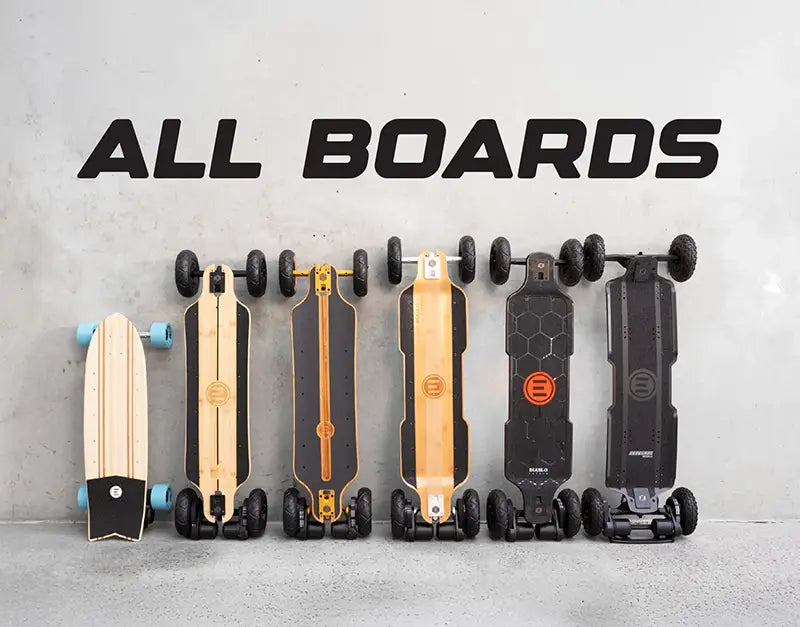
Best electric skateboard for off-road trails and bush tracks

Off-road electric skateboarding is harder than it looks. Here's what actually handles it.
Most riders who venture off sealed paths for the first time make the same mistake. They take a capable board, hit a gravel trail or rooted bush track, and find out quickly that grip, width and suspension are doing far more work than the motor ever will. Power is easy to find. A setup that can use it on uneven ground is a different matter.
New Zealand is one of the better places in the world to test this properly. The terrain variety here is genuine. Auckland's volcanic trails, Wellington's steep ridge lines, the gravel paths around Queenstown, the river flats near Hamilton, Christchurch's port hills. These are not manicured bike paths. They are technical, unpredictable and often wet in the corners. What works on asphalt falls apart quickly out here.
The boards that survive this kind of riding share a few things in common. Wide trucks for lateral stability. Pneumatic tyres that can absorb the odd root and rock without transmitting the impact straight to your feet. Enough torque to push through loose ground without bogging down. And a deck that stays planted when the surface underneath it is doing something unexpected.
Why the board geometry matters more than the spec sheet
There's a tendency to evaluate electric skateboards by battery size and top speed. On trails, neither of those numbers tells you much. What you actually want to know is how wide the stance is, how the board handles at low speed on unpredictable surfaces, and whether the deck has enough rigidity to give you real feedback without transmitting every vibration up your legs.
Longer decks tend to be more stable on smoother ground but harder to manage when the terrain gets technical. A slightly shorter, more compact footprint lets you weight the board dynamically, shift your balance and respond to what's coming. That's especially relevant on bush tracks where the line changes every few metres.
Truck width is the other variable most people ignore until they're mid-corner on loose gravel. Wider trucks lower your centre of gravity and give you a longer axle to lean on. The difference between a standard 30 cm setup and something closer to 39 cm is significant. That extra width changes the physics of every turn, every weight shift, every moment of doubt at the edge of your comfort zone.
The Renegade Diablo is purpose-built for exactly this
The rest of the Evolve lineup can handle light off-road work. The Diablo Bamboo and Diablo Carbon are both available in all-terrain configurations and they handle gravel paths and grass without drama. But they're still fundamentally street boards wearing off-road tyres. The Renegade Diablo starts from a different design intent entirely.
The Renegade trucks are forged and CNC-machined at 39 cm wide. That's meaningfully broader than anything else in the range, and you feel it immediately. The board sits lower and wider, which gives it a planted, confident feel that doesn't waver when the ground moves underneath you. It's a smaller detail than the motor specs, but it changes the character of every single ride.
The deck is solid carbon fibre, rigid and direct. On rough terrain, this is actually an advantage. Flex absorbs energy, which feels good on sealed roads but becomes unpredictable when you're already managing an uneven surface. The Renegade gives you a direct connection to what the wheels are doing, which means better control in the moments that count.
Under that, you've got the same dual 3500W motors and 864Wh battery as the top-spec Diablo range. The 7-inch pneumatic tyres run on Evolve hubs and handle the kind of varied ground that makes most boards unrideable. Grass, dirt, gravel, roots, compacted trail surface. The range drops to around 50 km in all-terrain conditions, but that's still substantial for a single off-road session. Very few riders are putting 50 km through a bush trail in one go.
What binding compatibility actually adds
The Renegade Diablo is compatible with optional Renegade bindings, with both toe and heel straps available. On sealed roads this feels unnecessary. On a technical downhill trail, a loose-footed riding style starts to feel genuinely precarious. Bindings keep your feet locked to the deck through the rough patches, which lets you ride more aggressively and confidently without spending mental energy on foot placement.
You don't need to run them all the time. Many Renegade riders use toe straps only, which adds security without fully committing to the locked-in feel of a snowboard-style setup. It's worth experimenting with on longer off-road runs, particularly in Queenstown where trail gradients get serious fast.
The weight consideration is real, but so is the context
At 16.4 kg, the Renegade is the heaviest board Evolve makes. If you're comparing it to a street setup and asking whether you'd want to carry it up three flights of stairs, the honest answer is no. But that framing misses the point. This board isn't optimised for portability. It's optimised for handling rough terrain at speed with confidence, and the extra weight is partly what enables that stability.
For riders who primarily want a commuter board that can occasionally handle a dirt path, the Renegade is more than they need. A Diablo Bamboo All Terrain or even the Fusion All Terrain would serve that use case better and weigh several kilograms less. But if the trail riding is the primary goal and the sealed-road sections are just getting to and from the good stuff, the Renegade is the right tool. The 45%+ hill gradient capability means it handles whatever New Zealand's steeper trails throw at it.
Getting one in New Zealand
Evolve doesn't have a physical store in New Zealand. The board is ordered online and ships directly. For riders in Auckland or Christchurch, the turnaround is typically quick. For regional areas, allow a little extra time. Evolve's support team is reachable online and the help centre covers everything from maintenance to belt replacements, which matters once you're putting serious trail kilometres on the board.
Maintenance on the Renegade is straightforward by electric skateboard standards. Keep the AT tyres at 40 to 45 PSI, check the belts and drive gears after rough sessions, and clean the trucks if mud gets into them. Evolve boards use belt drive throughout the range, so there's no complex gear mechanism to worry about.
If you're serious about riding trails in New Zealand and you want a board that was actually designed for it rather than adapted to it, the Renegade Diablo is the honest recommendation. It's not a compromise in either direction. It's a purpose-built off-road electric skateboard, and on the kind of terrain this country offers, that specificity matters.
-
Posted in
electric skateboard, evolve
