

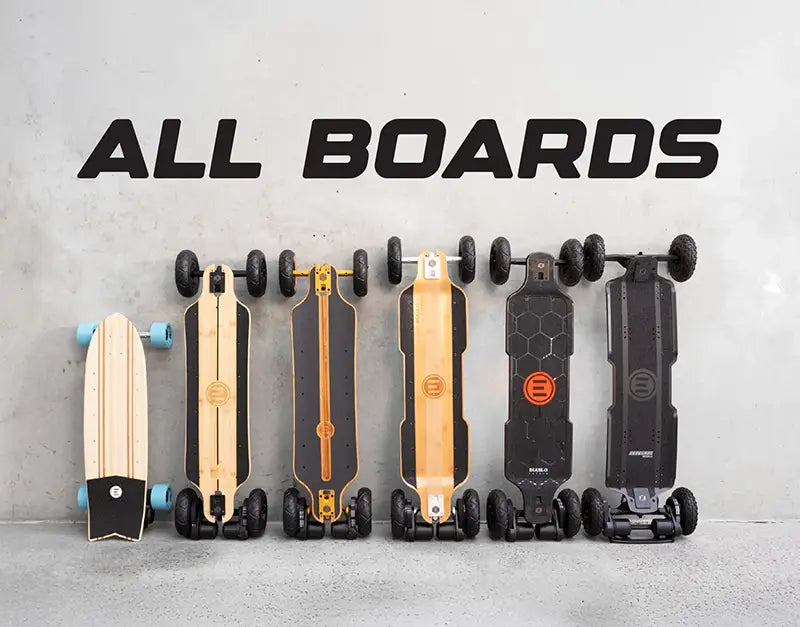

Are electric skateboards worth the money?

Are electric skateboards worth the money?
For most riders who commit to using one regularly, an electric skateboard pays for itself faster than expected. The honest answer depends on what you're replacing, how far you ride and whether you'll actually use it. But for commuting, recreational riding or genuinely replacing car trips, a quality board changes how you move through your day.
The harder question isn't whether they're worth it in general. It's whether the board you're considering is worth its price. That's where the difference between budget options and something like the Diablo Carbon All Terrain becomes very real, very quickly.
What you actually get for the money
Cheaper electric skateboards exist. Some are under $500. They typically come with hub motors that feel dead underfoot, battery packs that degrade quickly and speed controllers that deliver jerky, inconsistent throttle. They're fine until something goes wrong, and something usually does.
A board like the Diablo Carbon All Terrain sits at a different level entirely. The forged carbon deck is rigid, stable and lighter than its bamboo equivalent at 14.35 kg. Dual 3500W motors produce 7000W combined, with 45%+ hill capability and a 864Wh Samsung battery that delivers up to 50 km on all-terrain tyres. The EFOC 2.0 motor controller means smooth, predictable power delivery rather than the on-off lurch you feel on cheaper boards.
These are not marketing numbers designed to impress on a spec sheet. They translate into a board that feels planted at speed, climbs without struggling and brakes in a way that actually inspires confidence.
The commuting case
New Zealand cities are genuinely good for this. Auckland has an expanding network of shared paths and bike lanes. Wellington's flat waterfront stretches are ideal for a quick commute without touching traffic. Christchurch has one of the most developed cycling networks in the country. Hamilton's grid layout makes distance riding simple. Queenstown's trails and terrain are purpose-built for something like the All Terrain setup.
If you're replacing even two or three car trips a week, the maths shift considerably. Parking costs, fuel, time stuck in traffic. An electric skateboard doesn't replace a car entirely for most people, but it regularly replaces the short trips that cars handle least efficiently.
The 50 km real-world range on the Diablo Carbon AT means you're not calculating whether you'll make it. The board holds voltage well under load, so range doesn't drop sharply on hilly routes the way it does with smaller battery packs.
The terrain reality
Street-only boards are more efficient on smooth asphalt. But New Zealand surfaces vary. Paths crack. Shared walkways have gaps and joins. Footpaths in older suburbs are uneven. The 175mm pneumatic all-terrain tyres on the Diablo Carbon AT absorb that variation in a way that urethane wheels simply don't.
The rigid carbon deck works with this setup rather than against it. On a bamboo board, flex and pneumatic tyres can create a vague, disconnected feel at speed. Carbon keeps the feedback direct. You know what the surface is doing, which makes higher speeds feel more controlled rather than more anxious.
The Renegade Diablo exists for riders who want maximum off-road capability and are willing to carry a heavier board. For most urban and mixed-surface riding, the Diablo Carbon AT covers everything without that trade-off.
Maintenance and longevity
One of the genuine concerns with electric skateboards is running costs after purchase. Belts wear. Tyres lose pressure. Bearings need cleaning. These are real considerations, not reasons to avoid buying.
The question is whether the brand supports you. Evolve's service team handles diagnostics, parts and repair. The Explore app provides over-the-air updates, ride tracking and diagnostic data so you know when something needs attention before it becomes a problem. The 864Wh Samsung 50S battery is built to maintain capacity over hundreds of charge cycles when stored and charged correctly.
Boards that are serviced and cared for regularly last years. The initial cost spread across three or four years of riding looks very different to the upfront number.
Who should buy one
- Commuters covering 5 to 20 km each way on mixed or sealed surfaces
- Riders who want to replace short car trips without giving up comfort or reliability
- Anyone who has ridden a skateboard before and wants to cover more ground with less effort
- Heavier riders who need the 120 kg capacity and the stability that comes with a rigid platform
- People who live near trails, coastal paths or rougher terrain where street wheels aren't practical
Who should wait
If you're not sure you'll ride more than once a week, the calculation changes. An electric skateboard isn't a passive investment. It rewards riders who use it consistently. If your commute is entirely on uneven footpaths in poor weather, no board will feel ideal. New Zealand's wet seasons are worth planning around. These boards are built with splash resistance in mind, but none of them are rated for riding in rain, and water damage is not covered under warranty.
If budget is the main concern, the GTR Bamboo is a more accessible entry point with proven performance. But if you're asking whether a premium all-terrain board is worth the step up, the Diablo Carbon AT is the answer most riders come back to.
The honest verdict
Electric skateboards are worth the money when you buy one that matches your actual riding life and you commit to using it. The Diablo Carbon All Terrain is built for riders who want to cover real distances, handle varied terrain with confidence and own something that holds its quality over time. It is not the cheapest way to get from A to B. It is one of the best.
Order online and it ships directly to your door, wherever you are in New Zealand.
-
Posted in
electric skateboard, evolve
