
 (excl. BMX)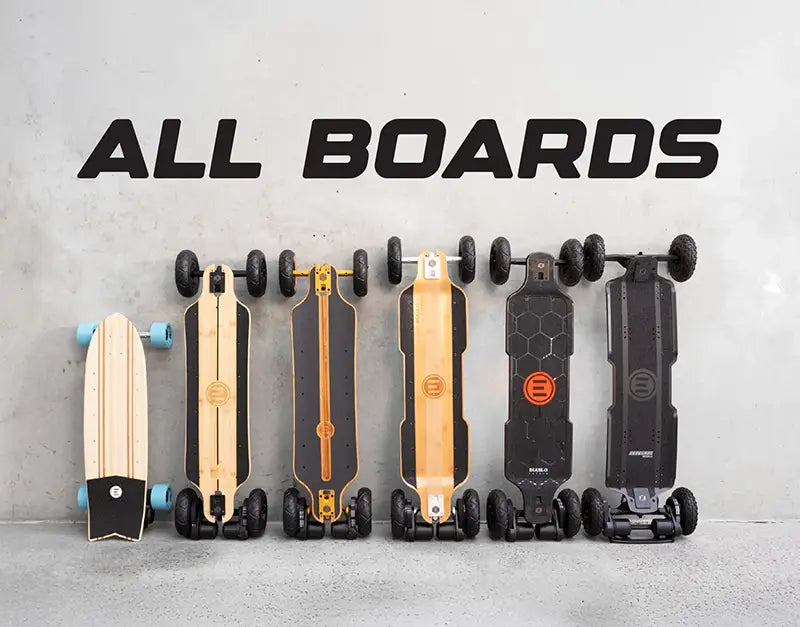
Belt drive vs hub drive electric skateboards explained

Belt drive vs hub drive: what the difference actually means for how your board rides
Most people researching electric skateboards come across the belt drive vs hub drive question early and assume it is mostly a mechanical detail. It is not. The drivetrain type is one of the most significant factors in how a board actually feels underfoot, how it handles different terrain, and how it holds up over time. Getting it wrong means riding a setup that fights your style rather than supporting it.
Evolve uses belt drive across the entire lineup, and that is a deliberate engineering choice. Understanding why helps you appreciate what you are actually paying for.
How each system works
A hub drive motor sits inside the wheel itself. The motor and the wheel are essentially the same unit. Power transfers directly from the motor to the ground with no intermediate components. It is mechanically simple, which is why it is common on entry-level boards. The motor is hidden, the profile is low, and there is not much to go wrong in theory.
Belt drive uses external motors mounted to the trucks, connected to the wheels via a rubber belt and a drive gear. Power from the motor travels through the belt to the wheel. There are more components involved, but each one is doing a specific job, and each one can be tuned, replaced or upgraded independently.
The difference in feel between these two systems is significant enough that most riders who try both notice it within a few minutes on the road.
Where hub drive shows its limits
Because the motor is the wheel in a hub drive system, the urethane layer around it has to be thin. Thin urethane means less cushioning, less grip and less control, particularly on rough surfaces. You feel every crack in the footpath. When the urethane wears down, you are often replacing the entire motor hub, not just a wheel. That is an expensive way to replace what is essentially a consumable.
Hub drive motors also tend to run hotter under sustained load. Because the motor generates heat inside the wheel, there is limited airflow to cool it. On a flat road this is manageable, but on steeper terrain or longer climbs, thermal throttling becomes a real issue. The board pulls back its own power to protect the motor, which is not what you want when you are halfway up a hill in Queenstown or grinding up one of Wellington's steeper residential streets.
Braking is the other area where hub drive falls short. The regenerative braking on hub drive systems tends to feel binary, either too soft or too abrupt. Modulating your stopping smoothly takes more effort than it should.
What belt drive does differently
The external motor placement in a belt drive system means proper motor cooling, consistent power delivery and meaningful torque. The motors are not constrained inside a wheel casing, so they can be physically larger and more powerful. Evolve's current motors run at 3500W each on the Diablo series, with torque output that handles steep gradients rather than pretending to.
The belt itself acts as a kind of mechanical buffer. It absorbs small shocks in the drivetrain and delivers power smoothly rather than in sudden surges. This is part of why carving on a belt drive board feels more natural. The power response follows your input rather than jumping ahead of it.
Braking on a well-tuned belt drive system is progressive and controllable. You can feather the brake through a long descent rather than grabbing it in pulses. For riders coming from surfing or snowboarding, that kind of modulation feels intuitive immediately.
Belts do wear and need replacing. That is a legitimate consideration. But a replacement belt is inexpensive and takes a few minutes to swap. Replacing a hub drive wheel motor is not. Over the life of a board, belt drive maintenance costs are manageable, and the performance advantage justifies them comfortably.
Why terrain changes the calculation
On perfectly smooth sealed surfaces, the performance gap between belt and hub narrows. Hub drive boards can feel adequate on a flat coastal path or a well-maintained footpath. But New Zealand's riding surfaces are rarely that forgiving.
Auckland's footpaths vary enormously between suburbs, with tree roots, chip seal and uneven joins common outside the CBD. Christchurch has stretches of excellent sealed path but also rougher roads in older residential areas recovering from years of repairs. Hamilton and Wellington both offer sealed paths alongside surfaces that punish a board with thin urethane and no shock absorption. Anywhere off-road is out of the question for hub drive.
If you want to ride across a mix of surfaces, or take the board off sealed paths entirely, belt drive is not just better. It is the only realistic option.
The Diablo Bamboo All Terrain as a practical example
The Diablo Bamboo All Terrain is a useful way to see what belt drive actually enables at the performance end of the range. It runs dual 6374 brushless sensored motors at 3500W each, connected to 175mm pneumatic all-terrain tyres through the belt drive system. The combination delivers 45 per cent gradient capability with a 864Wh battery that offers up to 50 km of range on the AT wheel setup.
That kind of capability is only possible with belt drive. Hub drive motors cannot physically fit in a wheel casing large enough to connect to 175mm pneumatic tyres, and even if they could, they would not produce the torque needed to climb serious hills under a 120 kg load.
The bamboo deck adds something here too. The natural flex absorbs trail vibration and road roughness in a way that a rigid deck does not. Combined with the pneumatic tyres and the progressive belt drive power delivery, the ride feel is genuinely different from what most people expect of an electric skateboard. It is closer to a snowboard run on packed snow than a motorised commuter device.
At 15.3 kg it is not a board you carry casually, but riding it justifies the weight. On loose gravel, grass, or unsealed tracks around Queenstown and beyond, it handles terrain that would stop most electric skateboards entirely.
Which system suits you
Hub drive suits a specific type of rider: someone who rides entirely on smooth sealed surfaces, values a low-profile setup, and is not concerned about high-performance torque or terrain versatility. For everything else, belt drive is more capable, more tuneable, and more rewarding to ride over time.
If you are in New Zealand and genuinely ride across mixed surfaces, you will feel the difference almost immediately. The combination of real torque, progressive braking, replaceable components and terrain flexibility is not something hub drive architecture can replicate. Belt drive costs more to produce and requires minor upkeep, but it delivers a riding experience that is in a different category.
For riders who want the full range of what belt drive enables, including off-road capability and the kind of torque that handles New Zealand's varied terrain with confidence, the Diablo Bamboo All Terrain is where that conversation ends.
-
Posted in
electric skateboard, evolve
