
 (excl. BMX)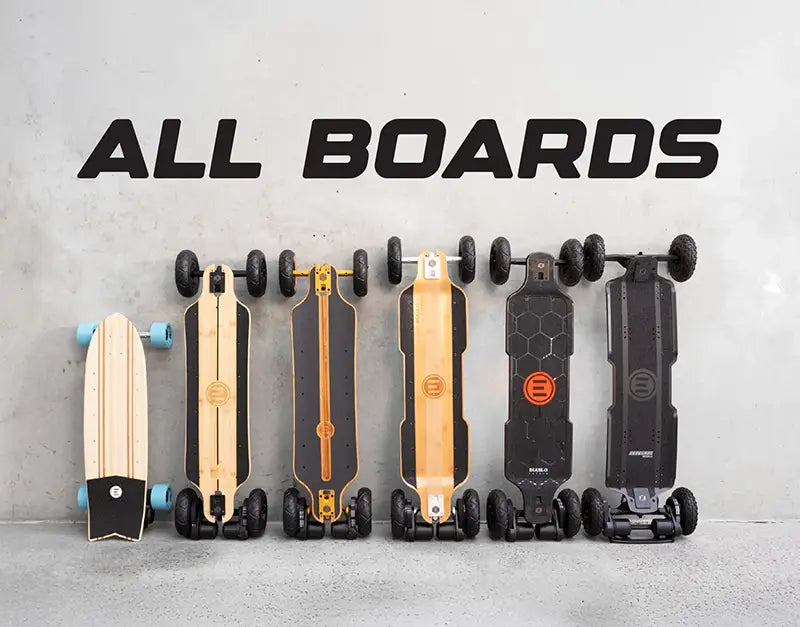
Deck length and wheelbase: how board size changes your ride
How deck length and wheelbase actually change the way a board feels
Most riders compare electric skateboards on speed and range. Those numbers are easy to find and easy to compare. What is harder to communicate, and what actually determines whether a board feels right underfoot, is geometry. Specifically, how long the deck is and how far apart the trucks sit.
These two dimensions shape everything: how the board turns, how stable it feels at speed, how planted you feel on rough ground and whether the whole thing flows or fights you. Getting them wrong is the most common reason a technically capable board still feels unsatisfying to ride.
What wheelbase actually controls
Wheelbase is the distance between your front and rear axles. It is not the same as deck length, though the two are related. A longer wheelbase means the trucks are further apart, which increases straight-line stability and makes the board feel more composed at higher speeds. A shorter wheelbase makes the board more responsive to foot pressure, which means tighter turns and a more skatey, dynamic feel.
The practical effect is real. On a longer wheelbase setup, you can hold a comfortable speed over imperfect ground without the board wanting to wander or twitch. On a shorter setup, every weight shift translates more directly into direction change, which feels playful at lower speeds and demands more focus at higher ones.
Neither is objectively better. They suit different riding contexts and different preferences. What matters is understanding which one matches how and where you actually ride.
Deck length is about more than just foot space
A longer deck gives you more room to adjust your stance, which makes a real difference on longer rides or mixed terrain. When you are covering distance across varied ground, being able to shift your weight forward or back without running out of board beneath your feet reduces fatigue and gives you more options for how you respond to changes in the surface.
Shorter decks are easier to carry, easier to navigate in tight spaces and generally feel more nimble underfoot. They suit riders who are hopping between destinations or who want something that feels closer to a traditional shortboard. The trade-off is less stance flexibility and slightly less stability at the top end.
Deck material also plays into this. A bamboo deck has natural flex, which softens road vibration and gives the ride a more forgiving, fluid character. A carbon fibre deck is rigid, which feels planted and precise but transfers more of the ground texture through to your feet. Same geometry, different sensation.
Why terrain changes everything about this conversation
On smooth sealed roads, wheelbase and deck length affect mostly how a board carves and holds its line. On mixed or rougher terrain, those dimensions start to matter in additional ways. A longer wheelbase keeps the board more stable when a wheel drops into a crack or rolls over gravel. The geometry works in your favour rather than amplifying every surface irregularity.
New Zealand's riding environments vary considerably. Auckland's waterfront paths and suburban streets are mostly sealed and forgiving. Wellington's terrain is more varied, often hillier, with surfaces that change depending on which route you take. Christchurch has some genuinely smooth cycling infrastructure but also plenty of rougher ground once you move off the main paths. Hamilton's flat, connected layout rewards a board that rides efficiently on street. Queenstown is in a category of its own: if you are riding there, you want something that can handle the kind of surfaces that come with riding near trails, gravel access roads and uneven lake-side paths.
The point is that in most New Zealand riding conditions, versatility is not a bonus feature. It is close to a requirement.
Where the Fusion sits in this
The Fusion All-Terrain runs a 96 cm deck with an adjustable wheelbase between 91 and 94 cm. That adjustability is worth paying attention to. You can dial the wheelbase to the shorter end if you want a more responsive, turn-focused feel, or open it up slightly for more stability on longer rides or rougher surfaces. It is a small adjustment with a noticeable effect.
At 12.5 kg, the Fusion is meaningfully lighter than the Diablo series. That weight reduction changes how the board behaves during the parts of riding that are not just straight-line cruising: manoeuvring around pedestrians, lifting it over a kerb, adjusting your stance mid-ride. The bamboo deck adds some flex to the equation, which softens the feel compared to a rigid carbon platform and suits the kind of flowing, surf-influenced style the board is built around.
The 175mm pneumatic all-terrain tyres do a lot of work on varied ground. They absorb surface imperfections in a way that street wheels simply cannot, and on the kinds of mixed-surface routes that come up naturally across New Zealand, that comfort has a direct effect on how long and how confidently you ride. Range sits at up to 40 km on all-terrain tyres, which covers most realistic sessions without requiring you to think too carefully about the return trip.
The dual 3000W motors handle gradients up to 35 per cent. That is sufficient for most urban hills, though if you are regularly climbing the steeper sections around Wellington's hilly suburbs or pushing into Queenstown's more demanding terrain, it is worth factoring that into your expectations.
The setup question most buyers skip
Most electric skateboard buyers spend time comparing specs between models and almost no time thinking about how geometry fits their riding style. That is partly because geometry is harder to quantify than watts or kilometres, and partly because most product pages do not explain it clearly.
But getting this right matters more than the last few kilometres of advertised range or a small power difference between motor configurations. A board that fits your riding style feels easy and natural from the first session. One that does not tends to feel slightly off in ways that are hard to name but constant.
If you are a rider who values flow over outright performance, who rides mixed terrain across varied New Zealand environments and who wants a board that handles the transition between a smooth path and a rougher track without demanding a lot of adjustment from you, the geometry and setup of the Fusion All-Terrain is a genuine fit. The wheelbase range, the bamboo flex, the pneumatic tyres and the overall weight all pull in the same direction.
Ordering online through Evolve NZ is straightforward, and the board ships ready to ride. If you want to understand the geometry in more detail before committing, the specs are worth reading carefully alongside this, rather than treating them as a secondary consideration.
-
Posted in
electric skateboard, evolve
