
 (excl. BMX)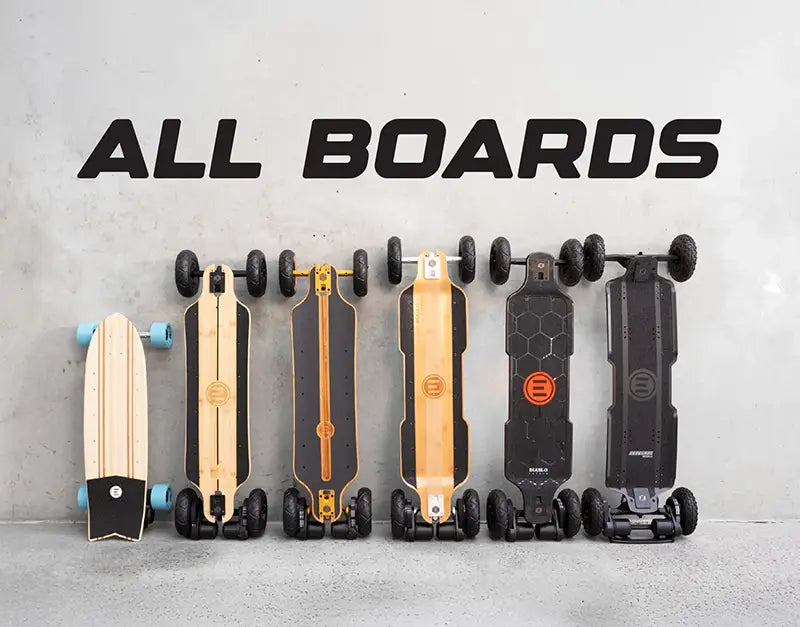
Electric skateboard battery technology explained

Electric skateboard battery technology explained
The battery is the most important component on your electric skateboard. It determines your range, your power delivery under load, how the board feels at speed, and how long the whole setup stays usable over years of riding. Understanding what sits inside the enclosure helps you make a smarter buying decision and take better care of what you own.
Cell chemistry and why it matters
Most quality electric skateboards use lithium-ion cells, but not all lithium-ion cells are equal. The cells used by Evolve across the current lineup are Samsung 50S, a high-drain 21700 format cell chosen for energy density and performance under sustained load.
High-drain cells can release more current without overheating or sagging in voltage. That voltage sag is what causes boards to feel sluggish halfway through a ride or lose braking confidence on a long downhill. Better cells hold their voltage more consistently, which means the board behaves closer to the same whether the battery is at 90% or 30%.
Cheaper boards often use lower-grade cells that perform well in ideal conditions but degrade faster and deliver inconsistent power as the pack ages. Over a two or three year riding horizon, the cell quality you start with matters a great deal.
Pack configuration: voltage, capacity and what those numbers mean
Battery specs are usually listed as voltage (V) and watt-hours (Wh). Voltage affects power delivery and top speed potential. Watt-hours are a measure of total energy storage, which is what drives real-world range.
Evolve boards run a 43.2V nominal system. The Diablo platform carries an 864Wh pack, which is among the largest in the production electric skateboard market. That capacity is what allows the Diablo Carbon All Terrain to deliver up to 50 km on all-terrain tyres without needing to manage your throttle anxiously from the first kilometre.
Pack configuration is written as cells in series multiplied by cells in parallel, such as 12S or 12S4P. Series cells increase voltage. Parallel cells increase capacity. The Diablo runs a 12S4P configuration, meaning four cells in parallel for each of the twelve series groups. That larger parallel count means a deeper energy reserve and spreads discharge current across more cells, which reduces heat generation during aggressive riding and keeps the pack running cooler under sustained load.
The BMS and what it protects
Every Evolve board includes a battery management system integrated into the pack. The BMS monitors individual cell groups and enforces safe operating limits. It prevents overcharge, over-discharge, short circuits and thermal runaway. It also balances cells during charging so that no single group drifts out of alignment with the others.
Cell balancing matters more than most riders realise. A pack where cells drift apart in charge level will lose usable capacity and age unevenly. The BMS keeps the pack coherent over hundreds of charge cycles, which is one reason a well-maintained Evolve battery holds its performance longer than a budget alternative with passive or no balancing.
How the motor controller interacts with the battery
The motor controller, or ESC, sits between the battery and the motors. On current Evolve boards this is the EFOC 2.0 controller, running field-oriented commutation at 50V and 200A. That matters because FOC control draws current more smoothly than older trapezoidal systems, reducing spikes that stress the battery and improving efficiency across the power range.
In practical terms, this is why the throttle on a Diablo feels progressive rather than on-off. The controller is shaping how current leaves the battery, not just switching it. Smoother current draw also means the pack runs cooler, which extends cycle life.
Real-world range versus rated range
Rated range figures are always best-case. They typically assume a lighter rider, flat ground, moderate speed and favourable conditions. Your actual range will vary based on rider weight, terrain gradient, average speed and how aggressively you accelerate and brake.
In New Zealand, where routes often involve significant elevation change, this is worth thinking about honestly. Riding from Wellington's waterfront up into Kelburn, or from Hamilton's river paths into the surrounding hills, will cut into range more than a flat coastal ride in Christchurch or a waterfront loop in Auckland. The 864Wh pack in the Diablo Carbon All Terrain provides enough headroom that real-world range stays meaningful even on hilly routes, rather than leaving you watching the indicator with twenty minutes of ride left in the session.
Queenstown terrain is in a category of its own. Steep descents with significant regenerative braking, followed by long climbs back up, cycle the battery in ways that flat riding never does. A larger pack handles that profile better because it absorbs more regenerated energy and has more reserve for sustained climbing.
Charging, storage and long-term care
Lithium-ion cells degrade faster at the extremes of their charge range. Storing a board at full charge for weeks at a time or running it flat regularly both accelerate capacity loss. The practical guidance is straightforward: charge before riding rather than storing charged, disconnect once the charge is complete, and if you are not riding for an extended period, store the pack at roughly 40 to 50% charge.
Temperature matters too. Charging or storing a board in a very cold garage overnight before an early morning ride is not ideal. Cold reduces available capacity temporarily and stresses cells during the first few minutes of discharge. Let the board come to ambient temperature before riding hard if it has been sitting in the cold.
Use only the supplied charger. The fast charger included with Diablo boards is matched to the pack's charge rate. Third-party chargers with incorrect voltage or current profiles can damage the BMS or cells even if they appear to work initially.
Why battery size is a practical decision, not a spec race
A larger battery is not always better for every rider. It adds weight, increases cost and makes air travel impossible. The Stoke X and GTR Bamboo serve riders whose priority is a lighter setup with enough range for shorter sessions. The Diablo's 864Wh pack is the right tool when range, sustained performance and consistent power delivery over long and varied rides are what you actually need.
The Diablo Carbon All Terrain is built around that use case. The rigid carbon deck and wider pneumatic tyres are paired with a battery and motor system that can sustain performance across the kind of terrain and distances where lesser setups start to compromise. If your riding involves meaningful hills, mixed surfaces or sessions that run longer than most boards can manage, the battery capacity is as important as any other specification on the sheet.
Common questions about e-skate batteries
How many charge cycles does an electric skateboard battery last?
Quality lithium-ion cells like the Samsung 50S are rated for several hundred full cycles before capacity noticeably degrades. With good charging habits, partial cycles and proper storage, most riders find their battery performance remains strong well into years two and three of regular use.
Can I fly with my Evolve board?
Most current Evolve boards, including the Diablo Carbon All Terrain, have batteries that exceed the 160Wh airline carry-on limit. They are not suitable for air travel in their standard configuration. Always confirm with your airline before travelling.
Does regenerative braking charge the battery?
Yes. When you brake on an Evolve board, the motors act as generators and return energy to the battery. On long descents this can add a small but meaningful amount of charge back to the pack. Avoid braking heavily into a fully charged battery, as a full pack has limited capacity to absorb regenerated energy.
What happens if I ride above the rated weight limit?
Exceeding the rated load increases discharge current, generates more heat and puts additional stress on cells, belts and motors. The Diablo Carbon All Terrain is rated to 120 kg, which provides reasonable headroom for most riders including gear.
-
Posted in
electric skateboard, evolve
