
 (excl. BMX)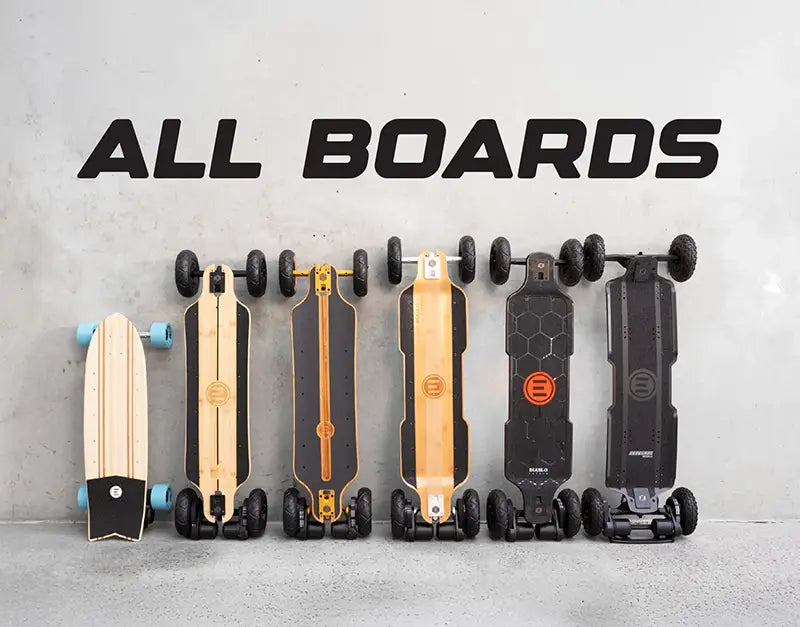
Cheap vs premium electric skateboards: what you pay for
What separates a cheap electric skateboard from a good one
Most people shopping for their first electric skateboard approach it like buying a laptop. They filter by price, compare numbers on a spec sheet, and assume the gap between a $400 board and a $2,000 board is mostly brand markup. It is not. The difference is real, and it shows up in ways that are hard to appreciate until you have ridden both.
That does not mean you need to spend as much as possible. It means you need to understand what you are actually paying for, because cheap boards and premium boards are solving fundamentally different problems.
Where budget boards cut corners
Entry-level electric skateboards tend to look fine on paper. The spec sheets often show competitive top speeds and range figures that seem reasonable. The problem is how those numbers are achieved, and more importantly, how long they last.
Generic hub motors are the most common cost-reduction point. They run hotter, have less torque and wear out faster than purpose-built belt-drive systems. Hub motors also embed the motor inside the wheel, which means when something fails, you replace the whole wheel. Belt drive systems, by contrast, let you replace a belt for a few dollars and keep riding. That distinction matters more than almost any spec on the page.
Battery quality follows the same logic. Cheap boards often use cells with lower energy density and less consistent discharge characteristics. You might get the advertised range on a flat road in perfect weather, but push up a hill or ride in the cold and you will feel the voltage sag immediately. That translates to sluggish acceleration, weaker braking and a range figure that shrinks faster than expected. It is not a bug. It is a consequence of the cells chosen.
Then there is the software layer. Budget boards typically offer limited or no tuning. You get what you get: fixed acceleration curves, fixed braking, fixed modes. If the default setup does not suit your riding style or your terrain, there is nothing you can do about it.
What premium actually buys you
At the premium end, you are paying for engineering that compounds. Better cells hold voltage more consistently under load, which means the speed and torque you feel at 100% battery is closer to what you feel at 30%. Better motors run cooler and deliver smoother torque across the full throttle range. Better controllers translate your input more accurately into motor output, which is why premium boards feel more alive underfoot, not just faster.
Adjustability is another thing budget boards rarely offer in any meaningful way. The ability to set your own acceleration curves, braking sensitivity and speed limits through an app is not a gimmick. For a new rider, it is the difference between a board that throws you off on the first hill and one you can actually learn on. For an experienced rider, it means dialling the setup to match specific terrain or conditions.
Support and longevity matter too. Cheap boards from unknown brands often have no local service options and no spare parts ecosystem. When something fails, and things do fail, you are either posting it overseas or writing it off. Premium boards from established manufacturers have service networks, available parts and the kind of institutional knowledge that means when you contact support, someone actually knows your product.
The total cost argument
This is where the cheap board case usually falls apart. A $400 board that needs a new battery after eighteen months, fails to handle Auckland's hills with any confidence, and gets replaced after two years has cost you more per kilometre ridden than a $1,800 board that is still going strong at year four. The upfront number is not the real number.
New Zealand terrain makes this calculation more pointed. Wellington's gradients are no joke. Queenstown's off-road tracks and lakeside paths demand a board that can handle varied surfaces without the rider white-knuckling the remote every time the road changes. Hamilton and Christchurch have long flat stretches that reward range and rolling efficiency. Auckland's mix of suburban hills and sealed coastal paths needs a setup that handles both without compromise. A budget board can survive some of this. It rarely thrives in it.
Where the GTR Bamboo All Terrain sits in all of this
The GTR Bamboo All Terrain is the point in the Evolve lineup where the value case becomes genuinely compelling. It is not the flagship, and it does not need to be. What it offers is a proven platform with real performance credentials at a price that sits well below the Diablo and Fusion series.
The belt-drive system with dual 3000W motors handles gradients above 25%, which covers most of what you will encounter on New Zealand roads and paths. The 504Wh battery returns up to 30 km on all-terrain tyres, which is honest real-world range for mixed surfaces. The 7-inch pneumatic tyres absorb the rough stuff, from chip seal to gravel tracks, without demanding that you slow to a crawl or pick your line obsessively. That is not a small thing when you are riding somewhere like the Queenstown waterfront or a rougher suburban footpath in South Auckland.
The bamboo deck has a natural flex that soaks up vibration and gives the ride a surfy, intuitive feel underfoot. It is not rigid carbon performance, but for everyday riding it is more forgiving, and more enjoyable for longer sessions. The Phaze remote and Explore app give you full control over acceleration curves and riding modes, which means a rider brand new to electric skateboarding can set it to ECO and build confidence gradually, while an experienced rider can open it up in GTR mode when the road calls for it.
At $1,899, it sits in a range that feels like a significant spend until you compare it against the actual cost of what budget alternatives deliver over the same period. Belt drive, Samsung cells, a proper motor controller, a tunable ride and a manufacturer you can actually call. That is what you are buying.
How to think about the decision
If you are genuinely uncertain whether electric skateboarding is for you, a cheap board is a reasonable way to find out. Just go in knowing it is a trial, not a long-term investment. If the riding sticks, you will likely find yourself looking at premium options within a year anyway.
If you already know you want to ride regularly, commute on a board, or explore terrain beyond smooth concrete, the economics point clearly toward spending more upfront. The riding experience is better from day one, the reliability holds over years rather than months, and the tuneability means the board grows with you rather than limiting you.
The GTR Bamboo All Terrain is not the most expensive way to find that out. It is probably the most sensible one.
-
Posted in
electric skateboard, evolve
