
 (excl. BMX)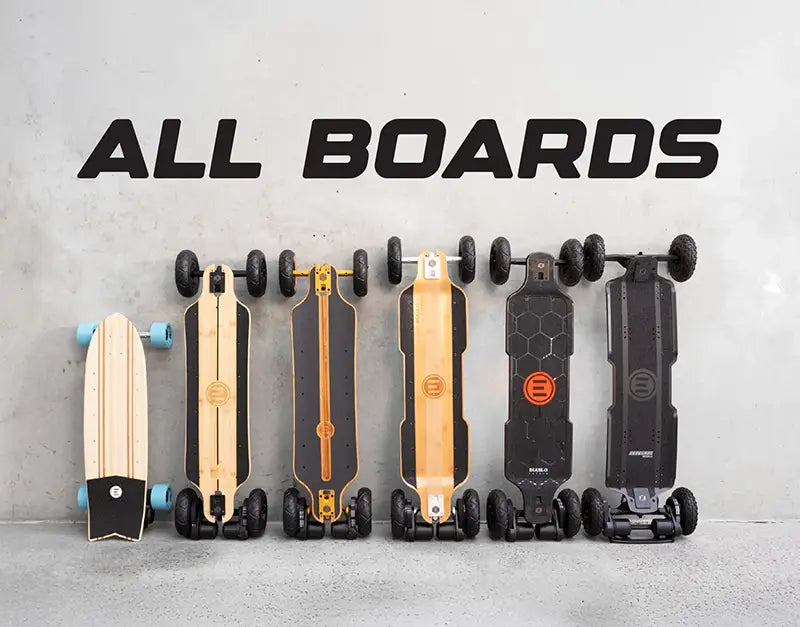
How much does a good electric skateboard cost?
How much should you actually spend on an electric skateboard?
Most people searching this question are trying to avoid two mistakes: spending too little on something that disappoints, or spending too much on something they did not need. Both happen constantly. The gap between a board that frustrates you after a month and one that becomes a genuine part of your routine is not always as wide as you think, but knowing where that line sits requires understanding what the money is actually buying.
There is no universal right answer. But there is a pattern. Boards under $800 tend to share the same weaknesses: inconsistent braking, limited range, poor motor controllers that clip acceleration and make the ride feel jerky. They are cheap because corners were cut on the components that matter most. Some riders make peace with that. Most do not, and end up buying again.
The real cost of going cheap
The appeal of a $400 electric skateboard is obvious. The problem shows up about three months in, usually on a hill or in the middle of a longer ride than the board was really designed for. Budget boards are often rated optimistically. Range figures assume flat ground, light riders and mild temperatures, none of which describe a typical commute in Wellington or a coastal ride in Auckland. When reality diverges from the spec sheet, the experience gets frustrating fast.
Then there is the support question. Replacement parts, firmware updates, warranty claims. With budget boards, these are often afterthoughts. You find yourself waiting weeks for a belt or a remote that may or may not be compatible with your exact unit. That hidden cost of ownership matters.
Premium boards are not just faster or rangier. They are built around components that are designed to be serviced, updated and relied on. That distinction is easy to overlook when you are comparing numbers on a spreadsheet, but you feel it immediately when you ride one.
Where the value actually starts
In the current market, the $1,500 to $2,500 range is where electric skateboards become genuinely capable. Not just fast in a straight line, but responsive, tunable and comfortable across real terrain. Boards in this range typically use quality battery cells, proper motor controllers and trucks that are actually designed for the forces involved in electric riding.
The Evolve GTR Bamboo sits at the entry point of this category and it earns its place. Strong motors, a bamboo deck that absorbs road vibration naturally, and enough range for serious commuting. For many riders, it is the right answer. But it was designed around a slightly older architecture, and if you are buying a board today with the intention of riding it hard for the next few years, the Fusion generation is where the engineering has moved to.
What you get when you spend a little more
The Fusion All Terrain sits at $2,299 and it represents a meaningful step up from entry-level premium. The jump is not just in raw performance. It is in how the board handles the full range of conditions you actually encounter in New Zealand.
The 648Wh Samsung battery gives you up to 40 km of real-world range on the all terrain setup. That is enough for a serious commute, a weekend loop or a longer adventure without the creeping anxiety of watching the battery percentage drop faster than expected. The dual 3,000W motors handle 35% gradients with confidence, which matters on the kind of terrain you find approaching Wellington's hills or riding inland from the Christchurch plains toward the Port Hills.
The 175mm pneumatic tyres are what separate this setup from street-only boards. They absorb the rough edges that sealed NZ roads throw at you, the chip seal, the weathered footpaths, the gravel transitions between paths. A street board handles these with varying degrees of discomfort. The Fusion AT handles them without drama.
At 12.5 kg, it is lighter than the Diablo range and more manageable as a result. That matters if you are carrying it on public transport in Hamilton, lifting it into a car, or simply not wanting every ride to feel like a workout before you have even stepped on the board.
The terrain argument for New Zealand specifically
New Zealand is not a flat country. Auckland has constant gradient changes between suburbs and the waterfront. Queenstown's riding is spectacular but it is rarely smooth or predictable. Even Christchurch, which has more flat ground than most, mixes sealed paths with rougher surfaces once you get off the main cycle network.
A street-only board works in specific conditions. The all terrain setup works almost everywhere. For a rider who is not sure exactly where their riding will take them, or who wants one board that genuinely handles variety, the pneumatic tyre advantage is hard to argue against. You do not need to plan routes around wheel suitability. You just ride.
The question behind the question
When people ask how much a good electric skateboard costs, they are really asking whether it is worth the money. That depends entirely on how you use it. If a board replaces car trips, saves on petrol and parking, and gives you 30 minutes of actual enjoyment twice a day, the maths on $2,299 looks very different than if it sits in the garage after the novelty fades.
Evolve boards are ordered directly online in New Zealand, which means the process is straightforward regardless of where you live. No waiting around for a local retailer to have stock. The board ships to you and the support infrastructure sits behind it.
The Fusion All Terrain is not the cheapest board in the Evolve range. It is the one that handles the widest range of New Zealand riding conditions without asking you to compromise on anything that actually affects the daily experience. For most riders thinking seriously about an electric board that will still be their daily choice in two years, the $2,299 is the right kind of investment.
If you find yourself wondering whether to stretch the budget slightly from the GTR, the Fusion is where that decision resolves itself clearly. Better battery architecture, lighter weight, more capable controller and the kind of all terrain confidence that New Zealand's varied surfaces genuinely call for. That combination is what good actually costs.
-
Posted in
electric skateboard, evolve
