
 (excl. BMX)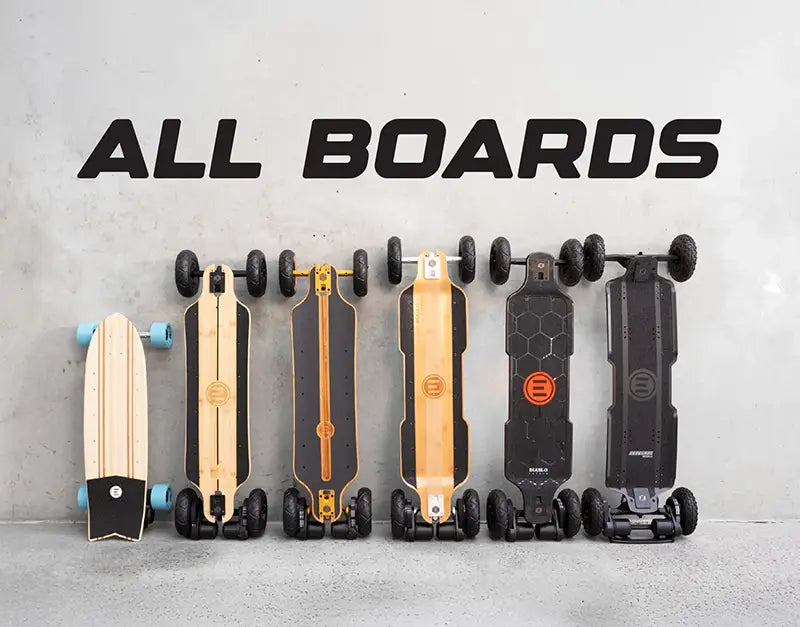
What electric skateboard range do you really need?

What electric skateboard range do you really need?
Most riders overestimate how much range they need, and end up paying for battery capacity that rarely gets used. Before you buy based on the biggest number on the spec sheet, it is worth understanding what range actually means in practice and which number matters for the riding you actually do.
The short answer is that most riders need between 20 and 40 km of real-world range. But the right number depends on your terrain, your riding style and how often you want to charge.
How real-world range differs from advertised range
Advertised range is measured under controlled conditions: flat ground, consistent speed, moderate rider weight. Once you add hills, variable throttle, heavier loads or all-terrain tyres, that number drops. Sometimes significantly.
A board rated for 40 km of all-terrain range might deliver closer to 25 to 30 km if you are heavier, riding aggressively or tackling repeated climbs. That is not a flaw in the product. It is just physics. The honest way to think about it is to take the advertised figure and mentally reduce it by 20 to 30 percent for real-world conditions. That becomes your planning number.
What kind of rider are you?
The most useful question to answer before choosing a board is not "how far can it go" but "how far do I actually ride in one session."
Daily commuters
If you are riding to work and back, most urban commutes in New Zealand fall somewhere between 5 and 15 km each way. A board with 30 to 40 km of real-world range covers that with enough buffer to avoid cutting it close. You want enough range that you are not watching the battery indicator on the return leg.
Weekend and recreational riders
If you mostly ride for enjoyment on weekends, sessions tend to run 15 to 30 km depending on where you go. Wellington's waterfront, Auckland's coastal paths and the Christchurch river trails are all in that range. You do not need a flagship 80 km battery for this. A mid-range board with a real-world figure around 35 to 40 km handles it comfortably.
Adventure and trail riders
If you are pushing into gravel tracks, mixed terrain or longer rides out of Hamilton or Queenstown, range becomes more critical. Pneumatic tyres draw more power, hill climbing eats into your buffer and you may be further from home when the battery runs low. For this kind of riding, choosing a board with a larger battery and proper all-terrain capability is worth the investment.
Why terrain matters as much as battery size
A street board and an all-terrain board with identical battery sizes will deliver very different ranges in practice. Pneumatic tyres create more rolling resistance than urethane street wheels, so an all-terrain setup will always use more energy per kilometre. Combine that with climbing gradient and the range gap widens further.
If your riding takes you onto unsealed paths, grass, gravel or hilly terrain, the calculation changes. You need a board that was designed for that kind of surface, not one that can tolerate it occasionally. The tyre choice, motor torque and battery size all need to work together.
The Fusion All-Terrain as a practical benchmark
For most New Zealand riders who want genuine all-terrain capability without overspending on range they will rarely use, the Fusion All-Terrain sits in a sensible position in the lineup.
It runs a 648Wh Samsung 50S battery with up to 40 km of all-terrain range and up to 60 km on street wheels. That covers the majority of real-world sessions, from the longer stretches along Auckland's waterfront to a mixed-surface ride through Christchurch or a hilly run in Wellington. The dual 3000W motors provide enough torque for 35% gradients, which is relevant if you are navigating any of the steeper residential streets or coastal tracks around New Zealand's main centres.
At 12.5 kg, it is meaningfully lighter than the Diablo series, which matters if you are carrying it on public transport, up stairs or into work. The adjustable wheelbase gives you some flexibility in how the board feels underfoot, and the 175mm pneumatic tyres absorb the kind of surface inconsistencies you encounter on shared paths and rougher trails.
The Fusion also converts to street with an Evolve conversion kit, so if you find yourself wanting more range or speed on sealed surfaces, you are not locked into one configuration.
When you should consider more range
There are specific situations where paying for a larger battery makes sense.
- Your regular ride is 30 km or more each way
- You ride in hilly terrain consistently and cannot predict energy use accurately
- You want to do longer group rides without needing to stop and charge mid-session
- You are riding at the top end of the weight limit, which reduces effective range
In those cases, stepping up to the Diablo Bamboo All-Terrain with its 864Wh battery and 50 km real-world AT range gives you that additional buffer. It is a different tool for a different set of demands, not simply a better board.
When you probably need less than you think
If your sessions are mostly under 20 km, you have access to a charger at both ends of your trip, or you ride mixed terrain occasionally rather than regularly, a mid-range battery is enough. Buying more battery than your riding requires adds weight, cost and charge time without adding anything meaningful to your rides.
The Fusion's 40 km all-terrain figure is not a limitation for most riders. It is genuinely more than enough for most sessions, most of the time.
A few practical questions to ask yourself
Before settling on a board purely based on range spec, run through these:
- What is my longest realistic single ride, not my theoretical maximum?
- Do I have somewhere to charge at my destination?
- Am I riding mostly sealed surfaces or genuinely mixed terrain?
- How much does weight matter for my commute or storage situation?
Answering those honestly will narrow the decision down quickly. Range is one variable. Weight, terrain suitability and battery efficiency all shape the actual experience more than the headline figure suggests.
If your riding takes you across varied terrain and you want a board that handles it confidently without buying more capacity than you need, the Fusion All-Terrain is worth a close look. It sits in a practical middle ground: capable enough for real adventure, light enough for everyday use and priced sensibly relative to the performance it delivers.
-
Posted in
electric skateboard, evolve
