
 (excl. BMX)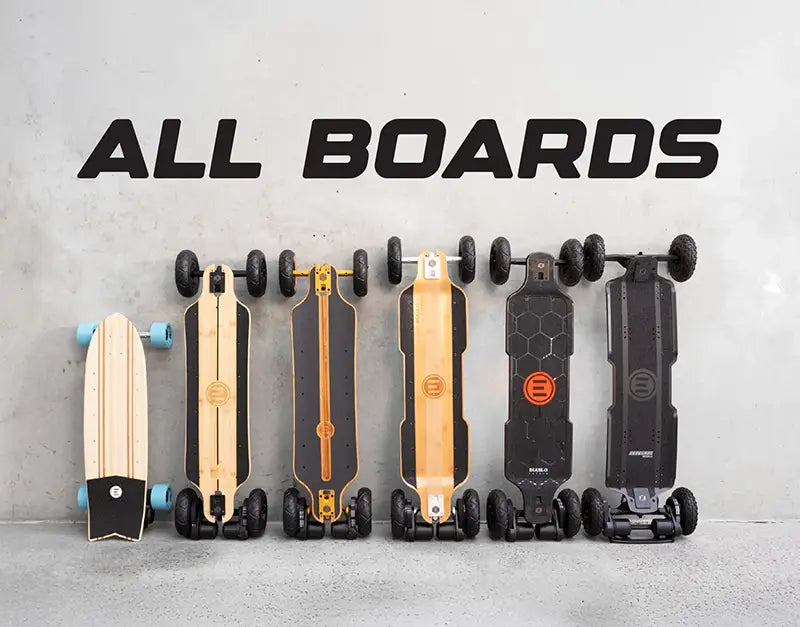
Diablo Bamboo AT vs Diablo Carbon AT: which should you choose?

Diablo Bamboo AT vs Diablo Carbon AT: which one is actually right for you?
Both boards share the same motors, battery and controller. The difference comes down to the deck, and that choice shapes how the board feels underfoot, how it handles at speed and how confident you'll feel pushing it hard. For most riders who want maximum stability and performance on varied terrain, the Diablo Carbon All Terrain is the stronger pick. But the Bamboo AT is a genuinely excellent board, and choosing the wrong one isn't as simple as carbon good, bamboo less good.
Here's how to work out which one suits you.
What they share
Start here, because the shared specs are substantial. Both boards run dual 6374 motors producing 3,500W each, a 864Wh Samsung 50S battery, EFOC 2.0 motor controller and SuperCarve 2 trucks. Both hit 50 km/h, handle 45% hill gradients and carry up to 120 kg. Both come with 175mm pneumatic all-terrain tyres and the Phaze remote.
Range on AT wheels is 50 km for both. Charge time is four hours. The riding modes, app compatibility and LED lighting system are identical.
In other words, the drivetrain is not the variable here. You're choosing between two deck materials, each with a distinct character.
The case for the Carbon AT
The Diablo Carbon deck is rigid. No flex, no give. What that means in practice is that every input you make translates directly into movement, with no energy lost through deck compression. At higher speeds, that rigidity becomes a genuine asset. The board feels planted, predictable and composed when you're pushing it.
At 13.15 kg on street wheels and 14.35 kg on the AT setup, it's actually lighter than the Bamboo equivalent despite the premium construction. The forged carbon deck integrates a CNC heatsink, which helps manage motor and controller heat during sustained hard riding. It also sits lower to the ground with a dropout foot placement that keeps your centre of gravity more stable.
For heavier riders, the rigid platform means less structural flex under load, which affects both the feel and the longevity of the board. If you're closer to the 120 kg limit, carbon is the more confident choice.
The Carbon AT also comes with integrated under-body and logo LEDs with smart brake lights, a step up from the standard LED setup on the Bamboo.
The case for the Bamboo AT
The Bamboo deck flexes. The 3-ply bamboo and 2-ply fibreglass construction absorbs vibration through the deck itself, not just through the tyres. On rough chip seal, gravel paths or uneven terrain, that translates into a noticeably more comfortable ride. It feels closer to a traditional longboard underfoot, more organic, more forgiving.
For riders coming from a surf or snowboard background, the flex pattern of bamboo tends to feel more intuitive. Carving on bamboo has a particular looseness to it that some riders actively prefer over the precision of carbon.
At $2,899 versus $3,199, the Bamboo AT is $300 cheaper than the Carbon. If you're primarily riding at moderate speeds, prioritising comfort over maximum precision, or simply prefer the feel of a board with natural flex, it makes complete sense.
Which terrain are you actually riding?
New Zealand's riding environments vary considerably. Auckland's volcanic geography means hills are unavoidable in most suburbs, and both boards handle those gradients confidently. Wellington's coastal paths and wind-exposed roads suit a stable, planted board, which nudges towards carbon. Christchurch has some of the flattest, smoothest sealed paths in the country, where bamboo's comfort advantage is more noticeable on longer rides.
In Hamilton, where flat suburban streets dominate, either board works well. But take a board to Queenstown, where you're likely to mix sealed roads, gravel tracks and genuine off-road terrain, and the carbon deck's composure at varied speeds and its tighter response to input becomes more valuable.
If your rides lean toward gravel, forest tracks or genuinely mixed surfaces, both boards handle it. The question is whether you want a board that floats over imperfections or one that cuts through them.
Rider weight and riding style
Rider weight is probably the clearest differentiator. If you're over 90 kg, the Carbon AT's rigid platform reduces the natural flex-under-load that comes with bamboo, which affects both ride feel and structural longevity. Lighter riders have more latitude to choose based purely on feel preference.
Riding style matters too. If you ride aggressively, hit higher speeds regularly or push the board on technical terrain, carbon rewards precision riding. If your sessions are longer cruises, exploring paths at a comfortable pace and carving through open space, bamboo is a legitimate preference, not a compromise.
A note on weight
This is counterintuitive: the carbon board is lighter. The Bamboo AT weighs 15.3 kg with AT tyres. The Carbon AT weighs 14.35 kg. Over a long ride or when carrying the board, that kilogram makes a difference. Both boards have the same 175mm pneumatic tyres, so the weight difference comes entirely from the deck material.
Which one to choose
Choose the Diablo Carbon AT if you want the most stable, high-speed platform in the Evolve lineup, particularly if you're a heavier rider, tend to push the board hard or value precise control over a more forgiving feel. It's the top-tier configuration for a reason.
Choose the Diablo Bamboo AT if ride comfort and a more natural flex feel matter more to you than rigid precision, you're lighter framed and riding at moderate speeds, or you'd prefer to put the $300 difference toward a conversion kit or accessories.
Both boards are ordered online with delivery across New Zealand. Neither requires a physical store visit to set up or ride, and both come with a 12-month warranty and 14-day money-back guarantee.
If you're still undecided, lean carbon. The weight advantage, stability at speed and long-term structural performance make it the easier board to grow into.
People also ask
Is the Diablo Carbon AT worth the extra cost over the Bamboo AT?
For most riders who push their board hard or weigh over 90 kg, yes. The Diablo Carbon AT is lighter, more stable at speed and built with a rigid platform that holds up better under sustained load. The $300 difference reflects a genuine performance upgrade, not just a cosmetic one.
Can I convert the Diablo Carbon AT to street wheels?
Yes. The Diablo Carbon 2-in-1 includes both wheel sets, or you can purchase a street conversion kit separately. Converting between AT and street requires a full kit, not just swapping wheels, as different drive gears and belts are involved.
Which Diablo is better for heavier riders?
The Diablo Carbon AT is the stronger choice for riders approaching the 120 kg maximum. The rigid carbon deck eliminates the flex-under-load that bamboo experiences, which improves both stability and the long-term structure of the board.
Does the bamboo deck wear out faster than carbon?
Not necessarily, but bamboo decks can develop micro-fatigue over time under heavy or aggressive use. Carbon is inherently more rigid and less susceptible to flex-related wear. For longevity under hard conditions, carbon has the edge.
-
Posted in
electric skateboard, evolve
