
 (excl. BMX)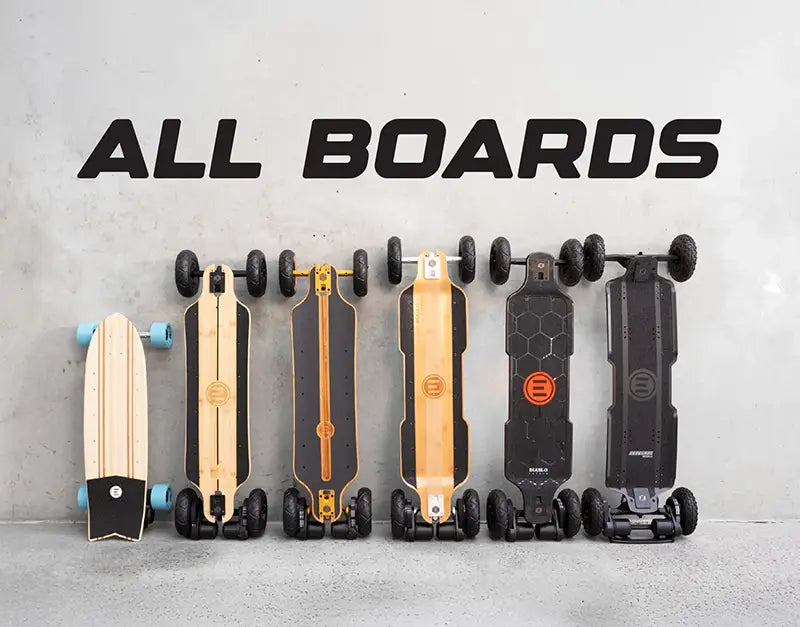
Which Evolve electric skateboard is right for you?

Choosing the right Evolve board is harder than it looks
Most people arrive at the Evolve lineup already knowing they want an electric skateboard. The harder question is which one. The range covers everything from compact commuters to serious off-road builds, and the gap between them is not just price. It is riding feel, intended terrain and what kind of riding you will actually do once the novelty settles and it becomes part of your routine.
New Zealand makes this question more interesting than most places. The country is not one kind of terrain. Auckland is long sealed paths and suburban hills. Wellington is wind and steep climbs. Queenstown is gravel tracks and mountain views. Christchurch has flat, well-sealed paths that reward speed and range. Hamilton sits somewhere in the middle, useful and underrated. Picking the right board means being honest about where you actually ride, not where you imagine you might one day ride.
Why most people get this decision wrong
The most common mistake is optimising for top speed. Riders see the spec sheet, compare top speeds and assume faster means better. In practice, most everyday riding happens nowhere near a board's top speed. What actually shapes the experience is how the board handles transitions, how it absorbs imperfect surfaces and how much confidence it gives you on a descent.
The second mistake is assuming street wheels will always be enough. New Zealand footpaths and shared paths are inconsistent. Sealed sections give way to chip seal, gravel shoulders or grass without much warning. A board built purely for asphalt can punish you for that, not catastrophically, but enough to make you hesitate before taking it out.
These two things together, overvaluing top speed and underestimating terrain variety, push a lot of riders toward the wrong setup.
The lineup, in plain terms
The Stoke X is the shortest board Evolve makes. It is light, fast enough for most commutes and genuinely easy to carry. If your entire riding life is sealed paths, light hills and short distances, it does the job with less board to manage. The tradeoff is a 100 kg load limit, no all-terrain option and a ride feel that rewards confident street skating rather than relaxed carving.
The GTR Bamboo has been around long enough to prove itself. It is the value entry into the serious end of the lineup and it handles both street and all-terrain configurations well. The 25 percent hill gradient rating is worth noting if you live somewhere with real climbs. It is a capable board, especially for riders who are still building their confidence with electric skating.
The Fusion sits above the GTR and below the Diablo in almost every way. Lighter than the Diablo at 12.5 kg, still capable of 50 km/h on street, and convertible between configurations with the right kit. It is a genuinely good board that suits riders who want performance without the full Diablo commitment.
The Renegade Diablo is built for people who want to leave the path entirely. Wider trucks, binding compatibility, purpose-built for dirt and gravel. If that is your world, nothing else in the lineup competes with it. But it is more board than most riders need, and heavier for it.
Where the Diablo Bamboo All Terrain fits
The Diablo Bamboo All Terrain is the board that makes the most sense for the widest range of New Zealand riders. Not because it is the most extreme option, but because it covers the most ground without asking you to choose between sealed and unsealed surfaces.
The 864Wh Samsung battery is the largest in the lineup. On all-terrain wheels it delivers up to 50 km of real-world range, which is enough for a serious day out without rationing throttle. On a route like the Christchurch Coastal Pathway or a longer Wellington waterfront loop, that range removes the calculation from the ride. You just go.
The 7-inch pneumatic tyres absorb the chip seal sections, the odd footpath edge and the gravel car park without drama. They do not require you to plan around imperfect surfaces. That is a quiet but significant thing, because terrain anxiety is real. Riders on hard street wheels develop habits around avoiding rough patches. On the Diablo AT, those patches stop being a problem.
The dual 3500W motors produce 7000W combined and handle 45 percent gradients. Wellington riders will know what that means in practice. Auckland's North Shore has a few streets that will test most boards. The Diablo Bamboo does not flinch at real hills, and the braking on descent is progressive and controlled through the EFOC 2.0 controller.
The bamboo deck contributes something the spec sheet does not fully capture. There is a small amount of natural flex underfoot that takes the edge off sustained vibration and gives the board a more intuitive carving feel than a rigid carbon platform. It is not a soft flexy cruiser board. It is composed and stable at speed. But it rides a little more like a longboard and a little less like a plank, and that matters on longer sessions.
Who should consider something different
If you ride exclusively on smooth sealed paths and rarely encounter hills above 15 percent, the Fusion Street gives you nearly the same performance at a lower weight and price. The Diablo Bamboo AT is a more capable board, but capability you never use is just weight you are carrying.
If you are a heavier rider, above 100 kg, the Diablo range's 120 kg load rating is worth the upgrade from the GTR or Stoke X. That rating is not just about structural integrity. It affects range, acceleration and braking behaviour in ways you will notice on every ride.
If genuine off-road riding is the goal, the Renegade Diablo is the more purpose-built answer. But the Diablo Bamboo AT handles the kind of mild off-road that most riders actually encounter, gravel tracks, grass paths, rough terrain between sealed sections, without the extra weight and width of the Renegade.
The practical reality of buying online in New Zealand
Evolve does not have a physical store in New Zealand, but the online buying experience is straightforward. The Explore app lets you tune the board before you ride and adjust as your skills develop. Riding modes from ECO through to CORSA mean the board can be dialled back to a manageable level for a new rider, then opened up gradually. That tunability removes a lot of the risk from committing to a more capable board early.
The Phaze remote is well designed for daily use. CNC aluminium body, dual trigger layout and a clear LCD screen. It is a tool that feels like it belongs with a premium product, not an afterthought.
If you are working through which configuration suits your routes best, the 2-in-1 version of the Diablo Bamboo includes both street and all-terrain wheel sets. For New Zealand riders who want flexibility across seasons and terrain types, that option is worth considering seriously. You are not locked into one setup.
The Diablo Bamboo All Terrain is not the cheapest board in the lineup and it is not trying to be. What it offers is a well-engineered platform that removes most of the limitations riders run into once they start taking electric skating seriously. For most people in New Zealand riding mixed terrain with any regularity, it is the board they will still be satisfied with two years in.
-
Posted in
electric skateboard, evolve
